Intensifying Intensifiers: Variations in Expressivity

in publications :: #DHDL

Abstract

Intensifiers define a larger word class that has fuzzy boundaries. Members of this class modify the degree of a gradable expression (typically a property, an adjective (phrase)), by strengthening its property. This word class contains a large set of (partly) paradigmatic words, originating from other word classes and various semantic origins, and it is marked by volatility (intensifiers emerge, stabilize, and disappear). From a communicative point of view intensifiers increase the expressivity of an adjective in an attributive or predicative function. Intensifiers do not only inform, they also perform. They function as expressive, emotive words that shift the attention to special, relevant spots in the information stream, as a kind of focus particles.

Investigating a German corpus of CMC consisting of Tweets, Blog- and YouTube-Comment: the frequency distribution of intensifiers shows considerable variation with a few frequent and many infrequent words. The referential meaning of intensifiers is relatively fixed, but their expressive meaning varies, also depending on their surprisal or information value, implying that more frequent intensifiers have lower surprisal values.

I hypothesize that the above strategies with different form-function patterns in intensifying intensifiers can be traced back to information values and the way these values are distributed over phrases and utterances. We apply alternative, more local information indices (information values from the Topic Context Model instead of global Shannon entropy) and information density measures to get a grip both on the tension between variation, convention and creativity in expressing intensification and on the pragmatic and structuring role of information values. At the same time, I claim a more established theoretical status of the concept of information in human communication.

Surprisal Theory

The Topic Context Model (TCM) is based on the Surprisal Theory of Hale (2001) and Levy (2008). It builds on Shannon’s information theory (Shannon, 1948; 1951) and on Dretske (1981), who distinguished between the quantitative measure of information in Shannon’s sense and semantic information, which transfers knowledge. Both types of information have an impact on brain activity. This is the starting point for the Surprisal Theory, which links information to the cognitive processing effort required (see Bentum et al. (2019l), Wilcox et al. (2023)). TCM measures surprisal, a quantitative measure which, in addition, due to its context, also incorporates the linguistic property of meaning. The surprisal of a word $w$ depends on its conditional probability in a given context, see Formula 1.

$$ \htmlId{formula1}{\mathrm{surprisal}(w_i) = -\log_2 P(w_i|w_1,\dots,w_{i-1}, \mathrm{CONTEXT})} \tag{1} $$

In the following three different surprisal measures are used, first frequency based unigram surprisal, refered to as IC, the other two are based on the TCM, referred to as TCM and TCM avg. TCM uses the new Formula proposed in Philipp (2026), see Formula 2.

$$ \htmlId{formula2}{\mathrm{surprisal}(w_d) = -\log_2\sum_{i\in T_d} P(t_i|d) f(w_d, t_i)} \tag{2} $$

TCM avg referres to the original Formula, see Formula 3.

$$ \htmlId{formula3}{\overline{\mathrm{surprisal}}(w_d) = -\phi\log_2\frac{c_d(w_d)}{|d|} - \frac{1}{|T_d|} \sum_{i\in T_d}\log_2 \left( P(t_i|d) f(w_d, t_i) \right)} \tag{3} $$

Here, $ c_d(w) $ is the frequency of a word $ w $ given a document $d$, $ |d| $ is the total number of words in the document $d$, so $\frac{c_d(w_d)}{|d|}$ denotes the relative word frequency in a document. Further $\phi\in{0,1}$ defines whether to use the relative word frequency or exclude it from the calculations, $T_d$ is the topic distribution $T$ of the document $d$ and let it be indexed such that $P(t_i | d) \geq P(t_j | d)$ if and only if $i\leq j$. Then pick a $\mu\in(0,1]$, also called threshold, and let $k_\mu$ be the largest integer such that $\sum_{i=1}^{k_\mu} P(t_i|d)\geq\mu$. For $k_\mu=0$ we still require $T_d^\mu={1}$ in order to keep the sets non-empty. See Formula 4 for the definition of $f(w_d,t_i)$, which gives the probability $P(w|t_i)$.

$$ \htmlId{formula4}{f(w_d, t_i) = P(w|t_i) = \begin{cases}WT_{w_d,t_i} & \text{ for } w \in WT \\ \frac{1}{N} & \text{ for } w \not\in WT\end{cases}} \tag{4} $$

Here $WT$ is the normalised word topic distribution $WT\in\mathbb{R}^{|T|\times N}$ of the Latent Dirichlet Allocation (LDA, the underlying topic model, \citet{blei2003latent}) and $N$ is the number of words. Further, we denote the entries of $WT$ by $WT_{w_d, t_i}$ and the columns in $\mathbb{R}^N$, which correspond to the topics, by $WT_{t_i}$. The notation $w\in WT$ means that there exists a row of $WT$ corresponding to the word $w$. The case that $w\not\in WT$ only occurs when using a TCM that was trained on different words than using to calculate surprisal for, i.e., a trained TCM is used on texts that were not part of the training corpus with new words.

Dataset

The texts used here come from several different datasets. First there are 25,399 blog posts and 35,317 tweets from the TwiBloCop, see Scheffler and Seemanni (2024). Second YouTube comments from the NottDeuYTSch-Korpus, see Cotgrove (2023), the comments are from the years 2014, 2015, 2016, 2017 and 2018, grouped into longer threads totaling 432 texts. And lastly tweets from the year 2022, from an not yet published corpus, also group into larger threads, another 8,563 texts.

Philipp (2024) gives a first analsysis of the intensidiers from the TwiBloCop and Van Hout (2026) takes a look at the four intensifiers mega, sehr, so and super from this combined dataset.

In total there are 69,711 texts with 6,055,120 tokens and 231,664 words. The texts from TwiBloCop average about 12 tokens per text, from the NottDeuYTSch-Korpus 2595 tokens per text and the remaining tweets average about 490 tokens per text.

Intensifiers

Here I focus on stacks consiting of a single intensifier, that is PoS-tagged as PTKIFG, followed by an adjective, PoS-tagged as either ADJ or ADJD. There is a total of 24953 stacks with 8106 different combinations of intensifier and adjective. The ten most frequent stacks are as follows. Considering that the TCM calculates document specific surprisal values for each word, in the following only th mean is reported.

stack frequency IC TCM TCM avg
sehr gut 878 9.2292 9.2552 10.1314 9.8570 28.2679 27.0318
so schön 287 7.3664 10.6960 8.7145 10.4640 33.3431 35.1160
ganz einfach 280 9.6688 9.1672 11.4429 12.4726 31.0541 32.0458
ganz gut 271 9.6688 9.2552 11.4003 9.8419 30.9966 26.8887
sehr schön 268 9.2292 10.6960 10.0855 10.0852 28.2045 34.0039
ganz ehrlich 259 9.6688 12.6440 11.4108 14.3996 31.4604 33.6124
so gut 257 7.3664 9.2552 8.8994 9.8632 32.5468 27.2854
ganz schön 246 9.6688 10.6960 11.4338 10.9873 31.0564 33.9866
ganz klar 234 9.6688 10.9632 11.4501 21.2528 31.0035 34.0702
so geil 231 7.3664 11.2530 8.6844 8.1658 33.2467 26.3549

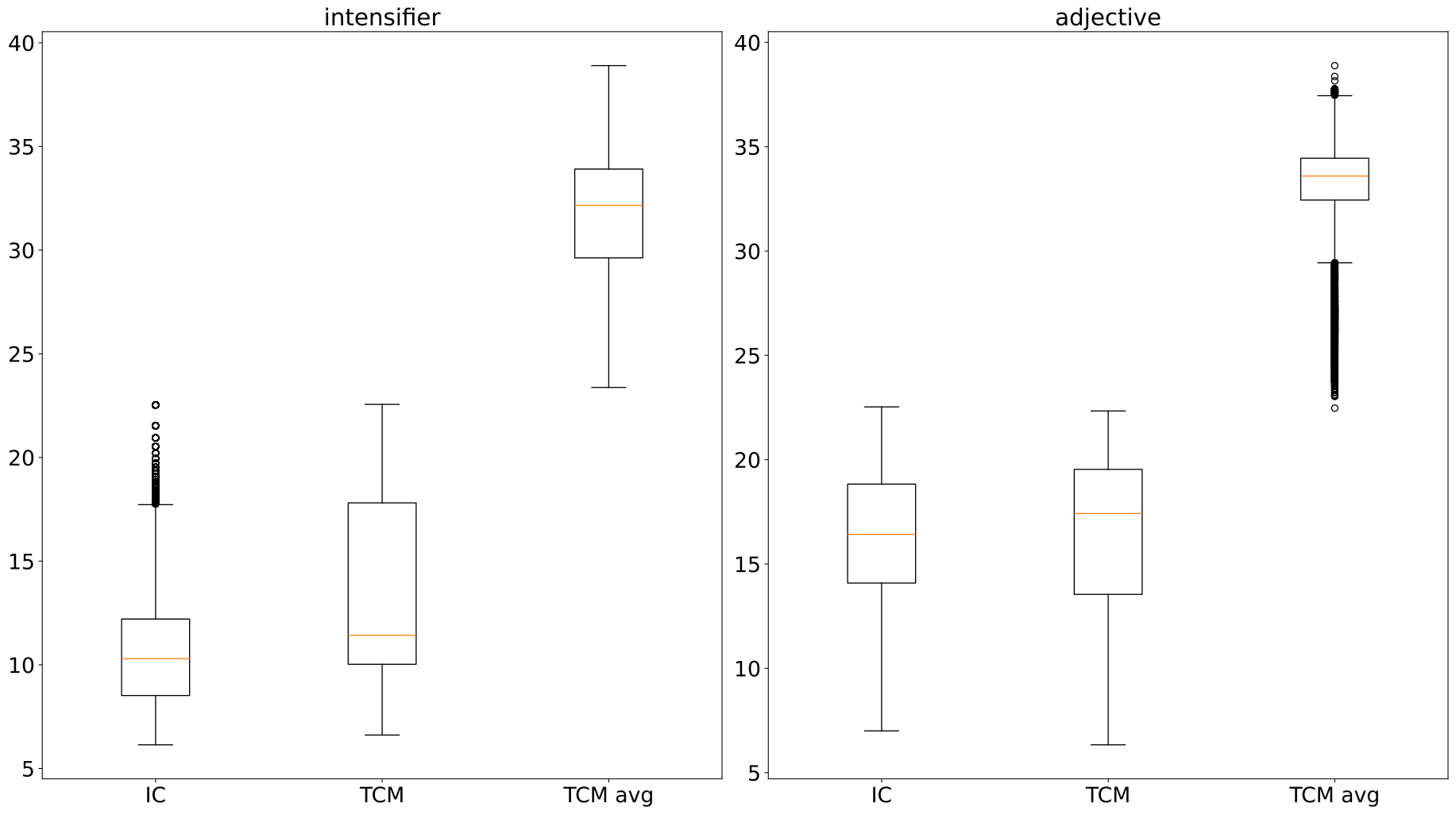
The following figure shows the surpisal distribution for intensifiers and adjectives for the three different surprisal calculation methods.
Surpisal distribution for intensifiers and adjectives.

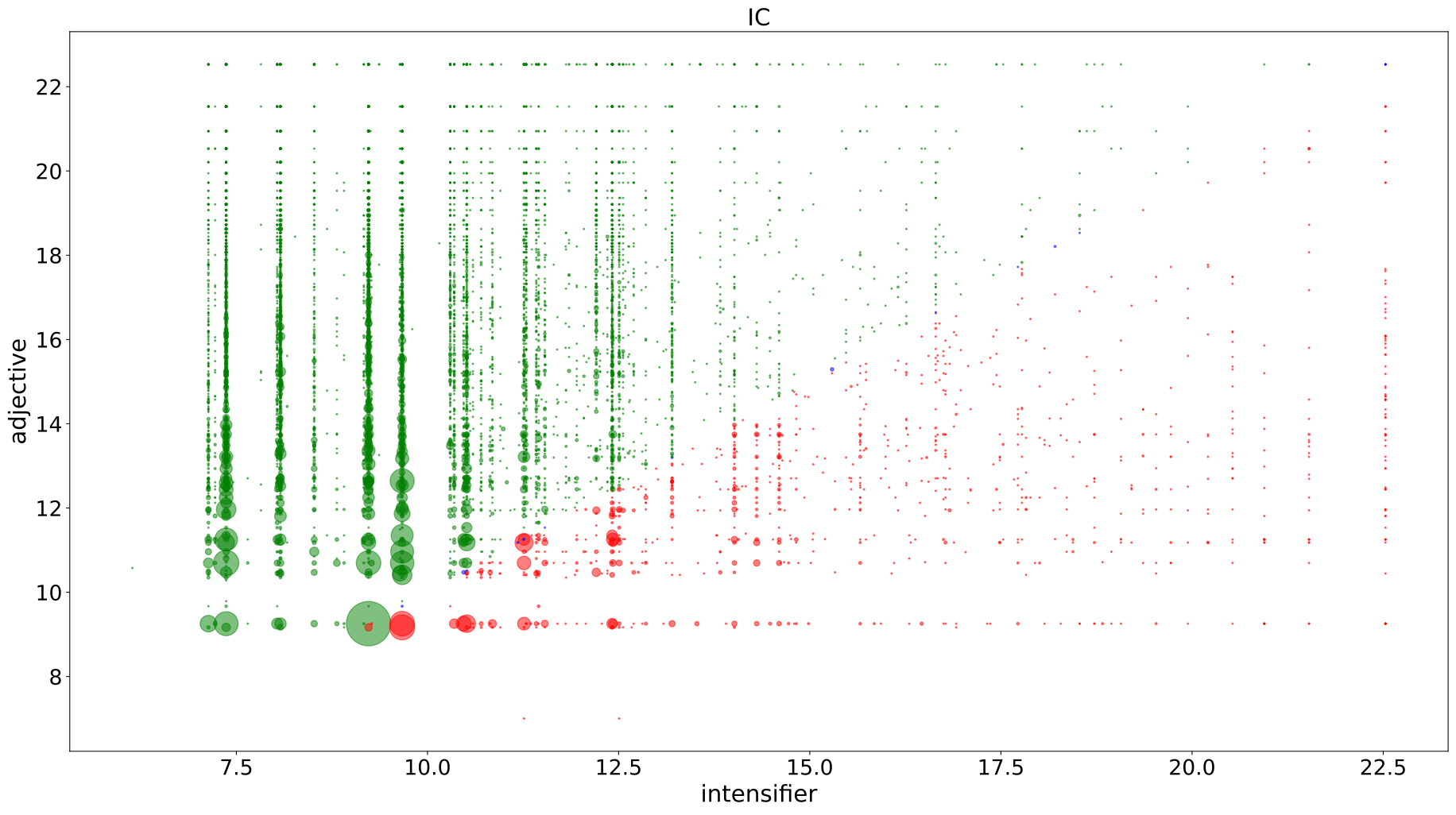
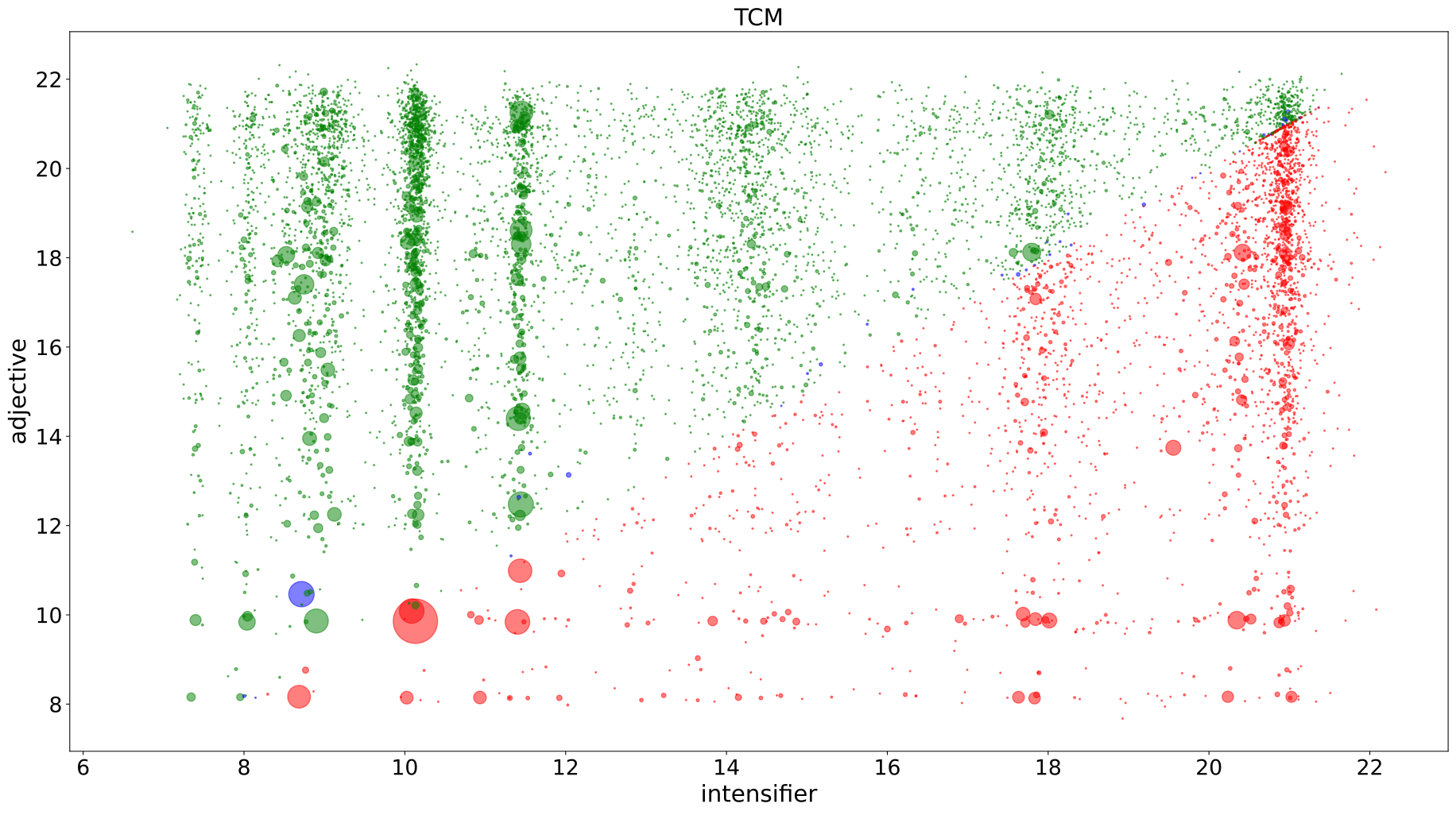
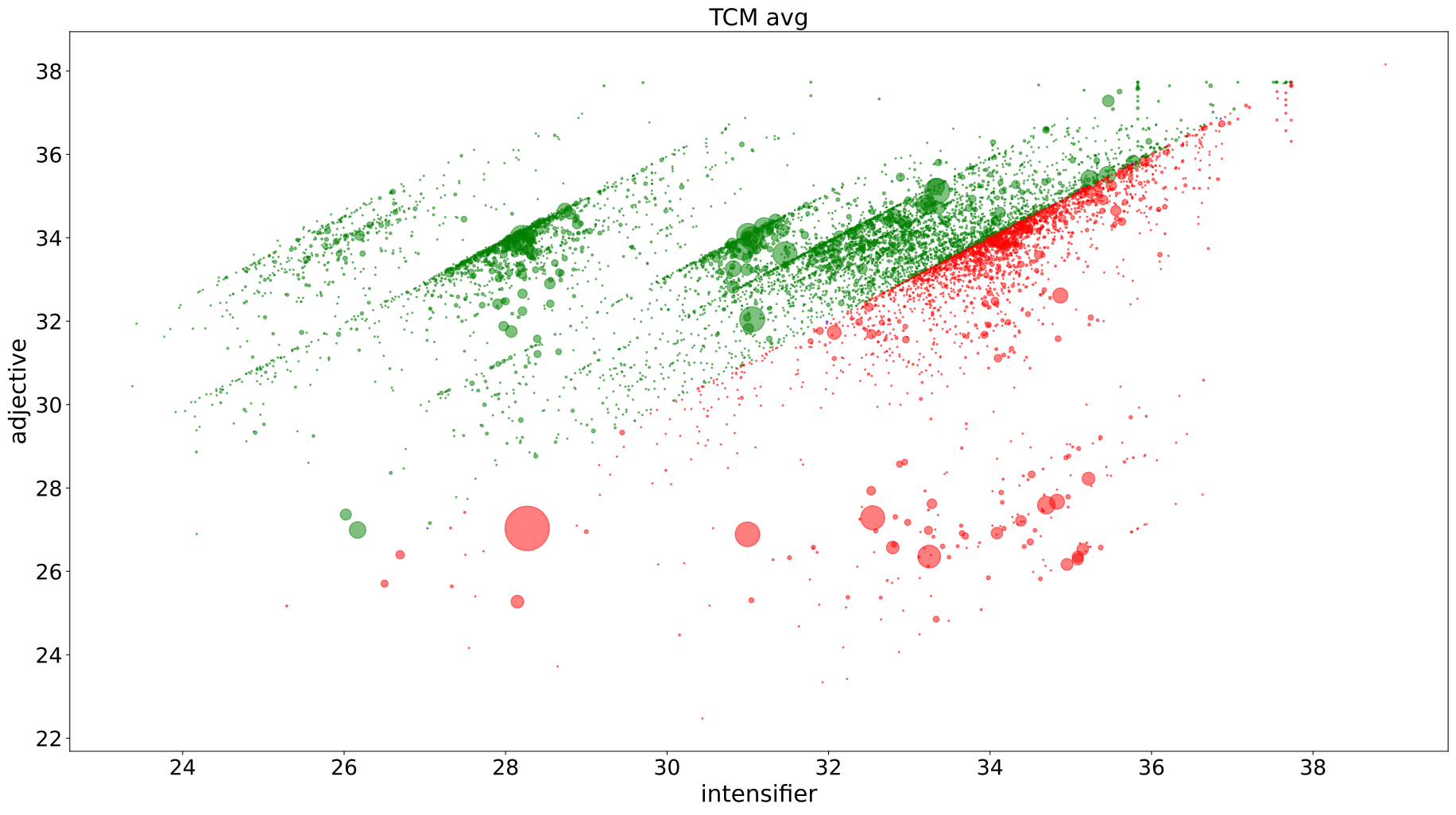
The following three figures take a closer look at the flow of information in stacks. In green are the stacks where the surprisal increases from the intensifier to the adjective, decreases are in read and blue if both surprisal values are equal.

Difference between intensifier and adjective based on the IC surprisal values, positiv information flow is green (7581 stacks), negative information flow is red (889 stacks) and no difference in surprisal values is blue (17 stacks). The larger the dot, the more frequent is the corresponding stack.
Difference between intensifier and adjective based on the IC surprisal values, positiv information flow is green (7581 stacks), negative information flow is red (889 stacks) and no difference in surprisal values is blue (17 stacks). The larger the idot, the more frequent is the corresponding stack.

Difference between intensifier and adjective based on the mean of the TCM surprisal values, positiv information flow is green (6089 stacks), negative information flow is red (2364 stacks) and no difference in surprisal values is blue (34 stacks). The larger the dot, the more frequent is the corresponding stack.
Difference between intensifier and adjective based on the mean of the TCM surprisal values, positiv information flow is green (6089 stacks), negative information flow is red (2364 stacks) and no difference in surprisal values is blue (34 stacks). The larger the dot, the more frequent is the corresponding stack.

Difference between intensifier and adjective based on the mean of the TCM avg surprisal values, positiv information flow is green (5937 stacks), negative information flow is red (2535 stacks) and no difference in surprisal values is blue (15 stacks). The larger the dot, the more frequent is the corresponding stack.
Difference between intensifier and adjective based on the mean of the TCM avg surprisal values, positiv information flow is green (5937 stacks), negative information flow is red (2535 stacks) and no difference in surprisal values is blue (15 stacks). The larger the dot, the more frequent is the corresponding stack.

The following figure shows the distribution of surprisal values for TCM and TCM avg for the stack sehr gut.
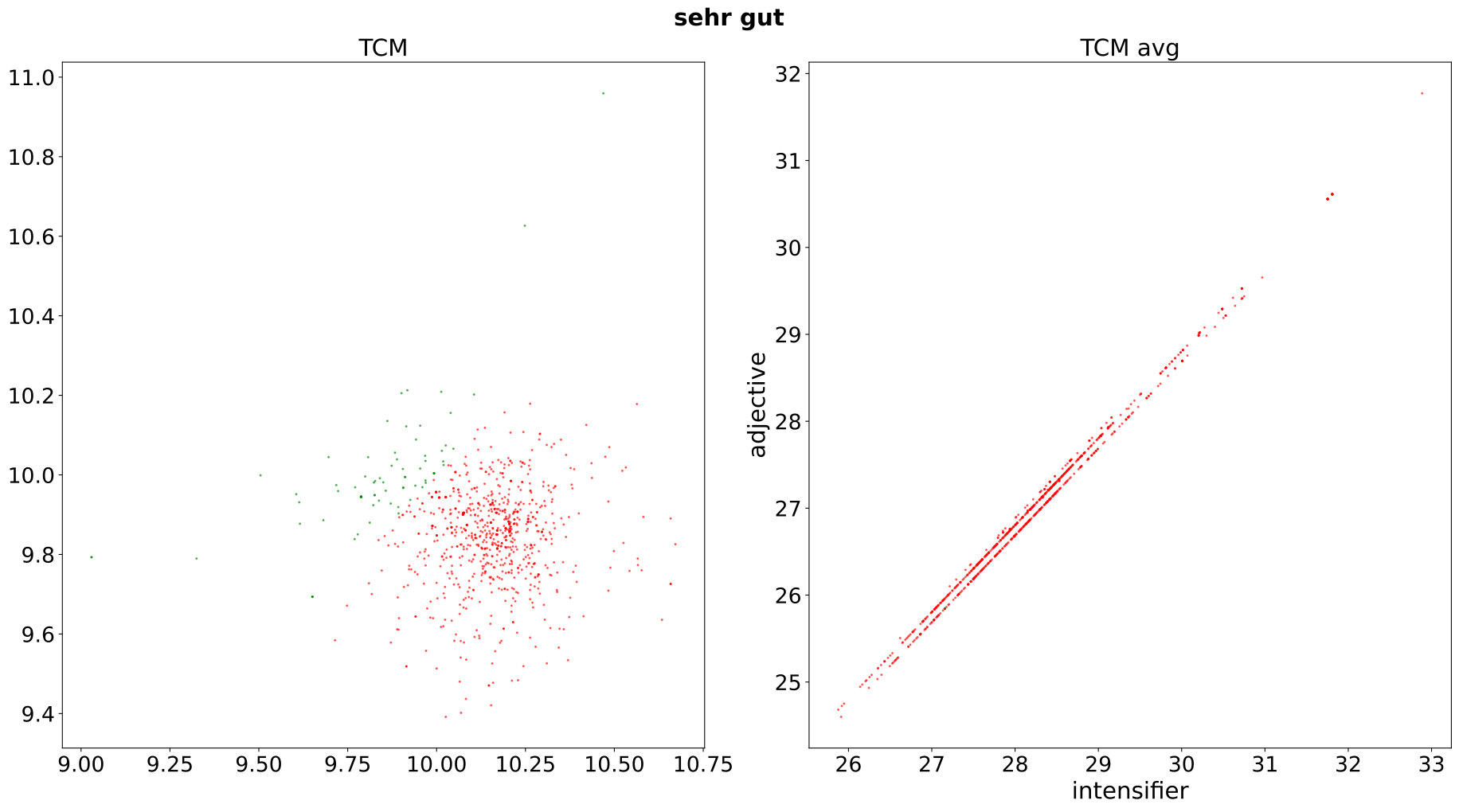
The distribution of surprisal values for TCM and TCM avg for the stack sehr gut.


Reinterpreting the surprisal calculation of the Topic Context Model

in publications :: #Konvens

In this paper, we propose and demonstrate an novel computation of wordwise surprisal within the information-theoretic Topic Context Model (TCM). Rather than calculating the average surprisal as in previous studies, the TCM is redefined to output a simple, non-averaged surprisal value. This adjustment facilitates a more straightforward comparison with other common surprisal models and measures, such as n-gram surprisal.

Poster


Beyond the Platform: APIs as part of the Workflow

in publications :: #TUC

The project 'Forschungsportal BACH' builds a comprehensive online repository that provides access to all surviving documents of the Bach family of musicians - the most influential family dynasty in music history - from the late 16th to the early 19th century. For the first time in the history of Bach research, the materials preserved in libraries, archives and private collections will be digitally recorded, indexed, processed, annotated and made available via an online portal.

For this purpose we do not only digitise the documents we want to present as a digital edition but in most cases the whole bundle or at least large sections of it. The pages will be automatically transcribed with Transkribus and made available online through a full text search.

The talk will cover our workflow from the image to the finished transcription, highlighting the different modes of interaction with Transkribus, both by humans and computer.


Intensifying intensifiers: Variations in expressivity

in publications :: #DGfS by Roeland Van Hout, J. Nathanael Philipp, Michael Richter

Intensifiers define a larger word class that has fuzzy boundaries. Members of this class modify the degree of a gradable expression (typically a property, an adjective (phrase), by strengthening its property. This word class contains a large set of (partly) paradigmatic words, originating from other word classes and various semantic origins, and it is marked by volatility. From a communicative point of view intensifiers increase the expressivity of an adjective in an attributive or predicative function. Intensifiers do not only inform, they also perform. They function as expressive, emotive words that shift the attention to special, relevant spots in the information stream, as a kind of focus particles. We investigate three recurring, innovative strategies in German CMC from Twitter conversations, and additionally from Blog- and YouTube-Comments:

(1) a. Stacking, by combining multiple intensifiers: so mega gut ‘so mega good’ b. Lengthening, mostly realised through repeated graphemes: soooooo cool ‘so cool’, seeeeehr schön ’very nice / beautiful’ c. (Modified) duplication, by repeating the same intensifier: sehr sehr gut ’very very good’

The frequency distribution of intensifiers shows considerable variation with a few frequent and many infrequent words. The referential meaning of intensifiers is relatively fixed, but their expressive meaning varies, also depending on their surprisal or information value, implying that more frequent intensifiers have lower surprisal values. We hypothesize that the above strategies with different form- function patterns in intensifying intensifiers can be traced back to information values and the way these values are distributed over phrases and utterances. We apply alternative, more local information indices (information values from the Topic Context Model) instead of global Shannon entropy and information density measures to get a grip both on the tension between variation, convention and creativity in expressing intensification and on the pragmatic and structuring role of information values. At the same time, we claim a more established theoretical status of the concept of information in human communication.

References: • Philipp, J. N., Richter, M., Scheffler, T. & R. van Hout (2022). The role of information in modeling German intensifiers. In R. Lemke, L. Schäfer & I. Reich (eds.), Information structure and information theory, 117–145. Language Science Press.

Abstract | Presentation


Semantic Information: A Difference that Makes a Difference

in publications :: #LREC by J. Nathanael Philipp, Max Kölbl, Michael Richter

In the framework of distributional semantics, we introduce a novel notion and operationalisation of semantic information for natural language. The key idea is as follows: a linguistic sign carries semantic information about a document if it reduces the amount of surprisal for a language processor. We consider two systems, an informed one and an uninformed one, and describe semantic information in their terms. Processing effort is quantified via surprisal where the informed system is 'aware' of the linguistic sign and the uninformed one is not. On an English fairy tale corpus and on two German news corpora, we tested successfully the prediction that if the linguistic sign in question carries pre-information through semantic surprisal, the current level of surprisal for the language processor is reduced. The conclusion is that the degree of semantic information results from the degree of semantic prior information.

Bibtex | PDF | LREC Proceedings


Vom Issue zur Edition: Der Workflow im Forschungsportal BACH

in publications :: #DHDL by Magdalena Auenmüller, Christine Blanken, Wolfram Enßlin, Nikolas Georgiades, Christiane Hausmann, Bernd Koska, Michael Maul, J. Nathanael Philipp, Nadine Quenouille, Till Reininghaus, Gregor Richter, Sophie Weber, Peter Wollny, Markus Zepf

Im Rahmen des Langzeitvorhabens ‚Forschungsportal BACH‘ wurde ein strukturierter Workflow entwickelt, der die Vielzahl an Arbeitsschritten von der Archivrecherche bis zur Veröffentlichung einer digitalen Edition systematisch abbildet und koordiniert. Dieser Workflow integriert automatisierte Prozesse, manuelle Bearbeitungsschritte sowie qualitätssichernde Kontrollphasen, um in einem interdisziplinären Team mit unterschiedlichen Kompetenzniveaus eine konsistent hohe Editionsqualität sicherzustellen.

Zur technischen Umsetzung wurde eine GitLab-basierte Infrastruktur etabliert, in der die einzelnen Arbeitsschritte mit Hilfe von Issues modelliert und mit den jeweils eingesetzten Werkzeugen (Forschungsportal, Darktable, Transkribus, TEI Publisher Annotationstool) verknüpft wurden. Das zugrunde liegende GitLab-Repository fungiert dabei nicht nur als zentrale Koordinationsplattform, sondern zugleich als redundantes Datensicherungssystem.

Poster | https://fdhl.info/dhdl25-projektuebersicht/#bach


Information theory unravels the subtext in Chekhov

in publications :: #DHQ by J. Nathanael Philipp, Michael Richter, Olav Mueller-Reichau, Matthias Irmer

The present paper reports a pilot study to approach the subtext in Chekhov's short-story "Ward No. 6" by means of information theory. The original text is enriched by glosses by which we intend to make explicit the implicit knowledge conveyed by the original text, i.e., the subtext. We generated several text variants with meaningful enrichments and one fake variant that served as a baseline. We could not observe that semantic surprisal as a feature of words and uniform information density have a subtext effect throughout all text variants. However, it turned out that kurtosis and skewness are suitable classification criteria to distinguish meaningful enrichments from fake enrichments.

Bibtex | Digital Humanities Quarterly


Surprisal in Action: A Comparative Study of LDA and LSA for Keyword Extraction

in publications :: #Konvens by J. Nathanael Philipp, Max Kölbl, Michael Richter

This study compares two methods of topic detection, Latent Dirichlet Allocation (LDA) and Latent Semantic Analysis (LSA), by using it in conjuction with the Topic Context Model (TCM) on the task of keyword extraction. The surprisal values that TCM outputs based on LDA and LSA are compared, both, directly and as inputs to a Recurrent Neural Network (RNN). While in the direct comparison LSA slightly outperforms LDA, LDA and LSA perform on a par when a Recurrent Neural Network (RNN) is trained with surprisal values. In general: semantic surprisal as input of an RNN improves its performance.

BibTex | https://aclanthology.org/2025.konvens-1.1/


Can information theory unravel the subtext in a Chekhovian short story?

in publications :: #SlavicNLP, #ACL by J. Nathanael Philipp, Olav Mueller-Reichau, Matthias Irmer, Michael Richter, Max Kölbl

In this study, we investigate whether information-theoretic measures such as surprisal can quantify the elusive notion of subtext in a Chekhovian short story. Specifically, we conduct a series of experiments for which we enrich the original text once with (different types of) meaningful glosses and once with fake glosses. For the different texts thus created, we calculate the surprisal values using two methods: using either a bag-of-words model or a large language model. We observe enrichment effects depending on the method, but no interpretable subtext effect.

Bibtex | Poster | ACL Anthology


The role of information in modeling German intensifiers

in publications :: #LanguageSciencePress by J. Nathanael Philipp, Michael Richter, Tatjana Scheffler, Roeland van Hout

In this study, context-free and context-dependent information measures are applied to a new corpus of tweets and blog posts. The aim is to account for the expressive meaning and characterize the variability of available intensifying items. It comes to light that context-free and context-dependent information measures are highly correlated and account for the distribution of intensifiers in the data, giving credence to the notion that intensifiers form a common word class, even across syntactic and semantic differences.

Both information measures show that stacked intensifiers tend to be ordered from least to most expressive within a phrase, i.e., the information tends to increase. We explain this fact using the Uniform Information Density Hypothesis: The first, less expressive intensifier is used to introduce the phrase, ease the reader’s processing load, and smooth the information flow.

BibTex | DOI: 10.5281/zenodo.133837